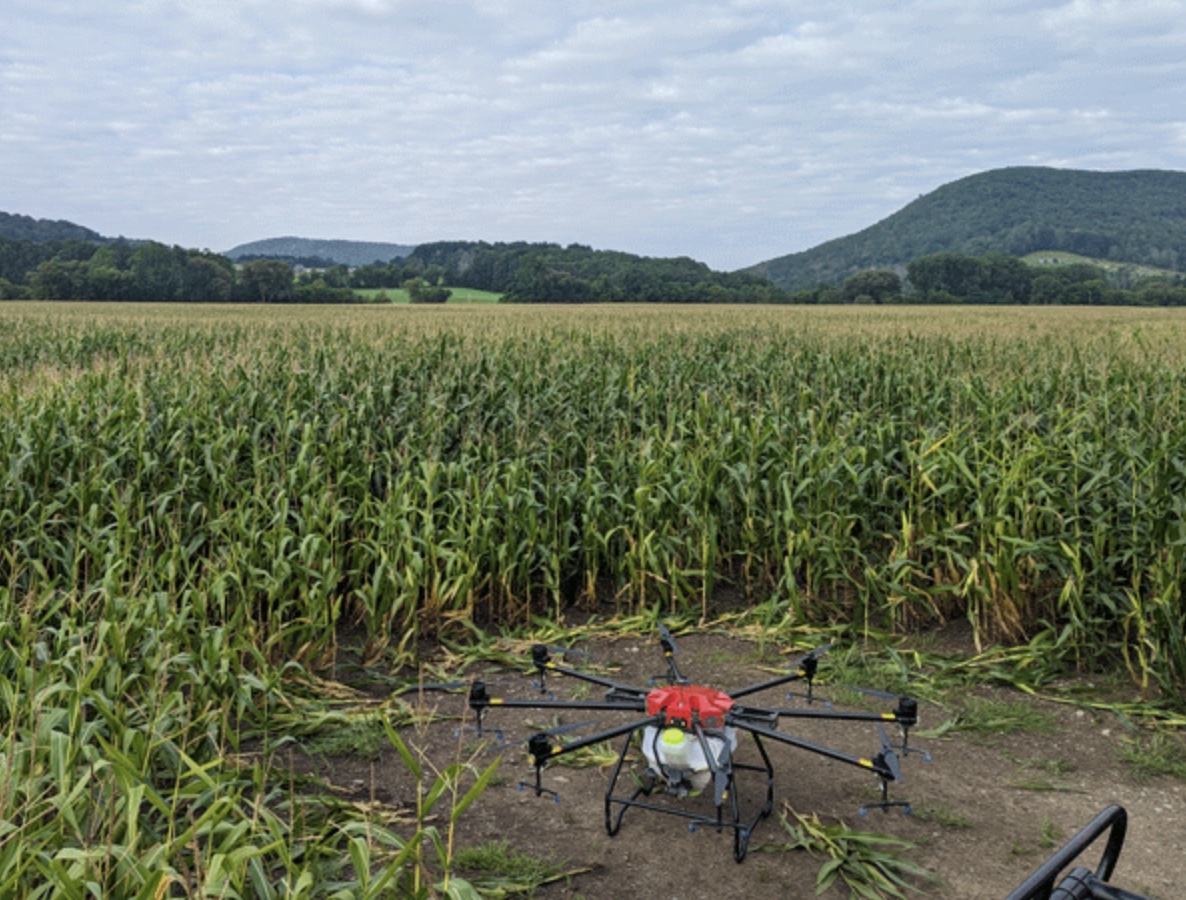
As with other types of emerging technologies, unmanned aerial vehicles, commonly called drones, have been making inroads in agriculture in making tough tasks easier. The 2024 Corn Congress included a panel discussion on drones titled "Using Drones for Effective Pest Management," featuring Rick Jordan, owner of CNY Drone Services in Clinton, NY; Tom Wolf, senior researcher with Agrimetrix Research and Training; and Bryan Young, weed scientist with Purdue University.
The Evolution of Agricultural Drones
Drone technology has evolved rapidly over the past decade, transitioning from experimental proof-of-concept applications to practical, cost-effective solutions for real-world agricultural challenges. What once seemed like futuristic technology is now becoming standard practice for forward-thinking farms and land managers across the nation.
Cost-Effectiveness in Hard-to-Reach Areas
One of the major advantages of drone technology in pest management is its cost-effectiveness, particularly in areas where manned aircraft cannot operate. Large agricultural equipment is impractical or impossible to deploy in certain situations—whether due to terrain, weather conditions, or the specific geography of a property. Drones fill this gap perfectly, providing aerial application capability at a fraction of the cost of traditional manned aircraft.
For forestry applications and land management in areas with difficult terrain, drone technology offers solutions that would otherwise be prohibitively expensive or logistically impossible. Properties that couldn't previously justify aerial treatment due to cost now have viable, cost-effective options.
Precision Agriculture Benefits
Drone technology enables precision agriculture in ways that were previously impossible. Rather than treating entire fields or properties uniformly, drones allow operators to target specific problem areas with exact application rates. This approach reduces chemical inputs, minimizes environmental impact, and improves overall results by focusing resources where they're needed most.
The ability to survey large areas quickly and create detailed maps of pest pressure, crop health, or environmental conditions gives farmers and land managers critical data for decision-making. This information-gathering capability, combined with targeted treatment application, represents a fundamental shift in how agricultural operations approach pest management and field optimization.
Integration with Modern Farming Practices
Drone technology integrates seamlessly with other precision agriculture tools and practices. Data from drone surveys can be combined with soil mapping, weather information, and crop health assessments to create comprehensive management strategies. This holistic approach to farming allows operators to optimize multiple aspects of their operations simultaneously.
Looking Forward
The future of drone technology in agriculture and pest management is bright. As the technology continues to advance, we can expect improvements in flight time, payload capacity, autonomous flight capabilities, and data processing. The integration of artificial intelligence and machine learning will enable even more sophisticated pest identification and treatment optimization.
Partnering with Experts
For farmers and land managers considering drone-based solutions, working with experienced professionals like CNY Drone Services ensures you get the full benefit of the technology. Professional operators bring years of field experience, understanding of regulatory requirements, and knowledge of application best practices that maximize effectiveness while ensuring compliance with all applicable regulations.